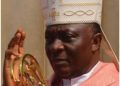
By this Sunday, it will be one week since Pope Leo XIV publicly named Nigeria among countries where Christians face persecution, and two weeks since Bishop Godfrey Igwebuike Onah of Nsukka delivered one of the year’s most incisive homilies—a damning critique of decades of discrimination, violence, and state indifference toward Christian communities. Separated by continents yet united in concern, both leaders have thrust Christian persecution back into the centre of national and global discourse, challenging Nigeria to confront its deepest wounds.
A Papal alarm heard around the world
On Sunday, Pope Leo XIV took to his official X account with a message that quickly reverberated across the globe. In a post laced by pastoral grief, he named Nigeria alongside Bangladesh, Mozambique, and Sudan as countries where Christians continue to face attacks, discrimination, and the destruction of places of worship. “In various parts of the world, Christians suffer discrimination and persecution. I think especially of Bangladesh, Nigeria, Mozambique, Sudan, and other countries from which we frequently hear of attacks on communities and places of worship,” the pontiff wrote.
The statement was a rare diplomatic rebuke—measured but unmistakable. Pope Leo’s remarks came amid mounting international scrutiny of Nigeria’s handling of religiously-motivated violence. This follows US President Donald Trump’s recent designation of Nigeria as a “Country of Particular Concern” over what he described as “Christian genocide,” warning that unless the killings cease, the United States might intervene militarily “to wipe out the jihadists.”


The Nigerian government swiftly rejected these claims, calling them “false, misleading, and a distortion of security realities.” Yet local and global voices of concern continue to grow. Pope Leo’s intervention adds moral weight to a narrative the government has long resisted. He appealed for solidarity, prayer, and action—not only for Nigeria but for victims worldwide. “God is a merciful Father who desires peace among all His children! …
Let us pray that all violence may cease and that believers may work together for the common good,” he wrote. Even as he prayed for Kivu in the Democratic Republic of Congo—where fresh massacres claimed dozens of lives—his message cast a long shadow over one of Africa’s largest Christian nations, raising an age-old question: Are Christians in Nigeria being systematically targeted?
Bishop Onah: ‘What Christians have suffered can be compared to the crucifixion’
Two weeks earlier, Bishop Onah stood before his congregation and delivered a homily that was equal parts lamentation and indictment. His words, widely shared by the citizenry especially in Christian communities, portrayed the emotional and historical context often missing from political debates. At the heart of his message was a striking metaphor: the crucifixion. “A number of things Christians have suffered in this country can be compared to the crucifixion of the Lord,” he said, his voice rising with urgency.
The bishop began by revisiting what he called a foundational injury: the takeover of Christian mission schools by the Nigerian government decades ago. Addressing the congregation, he recounted the sweeping confiscation that stripped churches of their educational institutions. “They took over those schools, destroyed them, turned our educational institutions into houses of formation of criminals and mediocres,” he declared. “That is like crucifying—because the school is a house of formation of character.” “They took over those schools, destroyed them, turned our educational institutions into houses of formation of criminals and mediocres,” he declared.
“That is like crucifying—because the school is a house of formation of character.” For Bishop Onah, the erosion of Christian educational institutions laid the groundwork for the country’s present moral and security crisis—a longterm wound from which the nation has yet to recover.
‘How many Churches have been burnt? Who keeps count of the dead?’
Turning to violence, Bishop Onah pressed deeper into the crucifixion analogy. “Who has the correct statistics of the number of Churches that have been burnt in this country? Who knows how many Christians have been killed because they are Christians?” His questions were less about numbers and more about justice—justice he says is rarely served. “How many of those who perpetrate these crimes have been arrested and prosecuted? How many are in jail? How many have faced the death penalty under Nigerian law?”
He criticised the state of “selective outrage,” noting that when innocent civilians are killed “there is silence,” yet when a criminal dies “in resistance or self-defence,” the reaction is instant and intense. “It is not only that they have killed him—they have taken the body away.” The biblical echo framed Christian suffering as a modern-day Passion story, a rhetorical device that highlighted the depth of grief and injustice.
The burden of impunity
Bishop Onah painted a stark picture of impunity: farmers displaced, lands seized, crops destroyed or fed to livestock, communities terrorised. Victims are silenced while perpetrators act with brazen confidence. “They kill, they rape, they maim, they sack farmers, they harvest crops of farmers and feed it to their cattle… And when you say, ‘Why are you doing this?’—it is death.” He noted that attackers sometimes film their violations and circulate the videos “to show the government,” yet face no consequences. In his view, such impunity has pushed some Christians toward retaliatory violence— only to be condemned the moment they resist. “Some Christians are being provoked legitimately to react… but when they react they are said to be taking the law into their own hands.”
The convergence of two voices
What makes this moment significant is not merely that a Pope and a Nigerian bishop have spoken—it is that their voices converge on a shared truth: Christian persecution in Nigeria is real, deep, and worsening. Pope Leo XIV speaks as a global shepherd, highlighting patterns of discrimination and violence with measured caution. Bishop Onah speaks as a local witness, drawing from lived experience, pastoral conversations, funerals, destroyed homes, and grieving communities. Together, they frame Nigeria’s religious crisis not as isolated incidents but as part of a broader moral emergency, demanding sincerity, justice, and reform.
A nation facing a defining moment
As Nigeria contends with rising insecurity, ethnic tensions, and political distrust, the papal spotlight has intensified pressure on government authorities. International partners are watching. Faith communities are mobilising. Christian leaders—like Bishop Onah—are refusing to remain silent. The question now is whether Nigeria will confront these warnings with humility and decisive action. Because, as Pope Leo XIV made clear, and as Bishop Onah asserted from his pulpit, peace in Nigeria is no longer something to be taken for granted.