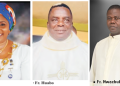
Nigeria is bleeding — not metaphorically, not symbolically, but literally. In a span of hours this week, gunmen stormed a Kaduna village and kidnapped a Catholic priest, slaughtered the brother of another, and whisked away terrified residents. Before the country could recover from that shock, 25 schoolgirls were abducted from their dormitories in Kebbi. And in the North-East, ISWAP terrorists executed a Brigadier-General, torched government vehicles, killed labourers, and left soldiers missing in action after a siege on a military base. Three regions. Three attacks. One message: Nigeria has lost control of its own security map. This is not random tragedy; it is a pattern — a grim rhythm of violence that has become the national soundtrack. And if Nigeria’s leaders still believe this is normal, the rest of us must insist: we are living through a national emergency.
A Priest taken, a community broken
The kidnapping of Rev. Fr. Bobbo Paschal in Kushe Gugdu, Kaduna, is not just another security incident — it is the latest entry in a long catalogue of clergy hunted like criminals in the line of pastoral duty. In the same attack, Mr. Gideon Markus, brother to another priest, was murdered. Several villagers were also abducted. This is Kaduna — where priests are shot on their way to Mass, where villages empty out at nightfall, where families sleep with one ear awake. The Church’s call for prayer is noble. But prayer cannot replace policy. Nor can lamentation substitute for law enforcement.

Schoolgirls snatched in the dead of night
Hours after Fr. Paschal’s abduction, terror swept into Kebbi State. In the pitch-black early morning, 25 schoolgirls from Government Girls’ Comprehensive Secondary School, Maga, were dragged into the bush. Their vice principal, Mallam Hassan Yakubu Makuku, was shot dead trying to defend them. Not even the memory of Chibok, Dapchi, Tegina, or Kuriga was enough to avert this — another headline, another heartbreak. How many Nigerian daughters must disappear before the nation admits that its classrooms have become hunting grounds?
A General executed, Soldiers missing
In Borno, ISWAP overran a base in Mayenti, leaving four Civilian JTF members dead, several soldiers missing, and public property in flames. This came on the heels of the execution of Brigadier-General Samaila Uba, filmed and circulated with the cold precision of psychological warfare. When terrorists begin killing generals — not just rank-and-file soldiers — the meaning is unmistakable: insurgents are growing bolder, more coordinated, more confident. Meanwhile, government statements remain predictable: condemnations, condolences, and promises that rarely mature into action.
America Warns, Nigeria wavers
Barely two weeks ago, the United States redesignated Nigeria as a ‘Country of Particular Concern’ over religious persecution and unchecked violence. That warning has been met not with reform, but with fresh bloodshed. Diplomatic pressure is useless if it does not translate into domestic accountability. The world is watching — but Nigerians are the ones dying.

The Church under Fire, the State under question
The Catholic Church is grieving yet again. Priests are not just collateral victims — they are increasingly deliberate targets. To attack a priest is to attack the conscience of a community, to burn down its moral centre. From Enugu to Kaduna, from Niger to Anambra, clergy have been killed, abducted, tortured. Their blood is fast becoming a symbol of the state’s inability — or unwillingness — to protect. This is no longer a “security challenge.” It is a collapse of the social contract.
Nigeria at a crossroads
There is no excuse left. Not poverty, not politics, not “complex security dynamics.” Nigeria’s armed forces are filled with brave men and women. But they cannot win a war the political class refuses to prioritise. Governor Zulum has again called for drones, technology, and coordinated offensives. Others have demanded sweeping reforms. But what Nigeria desperately needs is political will — backed by urgency, accountability, and consequences. The President must act. The service chiefs must act. The governors must act. And Nigerians must refuse to normalise this horror.
Enough is enough
Fr. Bobbo Paschal must not become another name on a growing list. The 25 kidnapped schoolgirls must not become another footnote. The slain Brigadier-General must not be another tragic statistic. And the countless missing civilians across the North must not disappear into silence. A country that cannot protect its priests, its children, or its soldiers cannot claim to be at peace. This is a moment of reckoning. Nigeria is running out of time — and out of lives. If this nation does not rise now, what will be left to rise for?