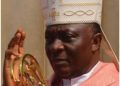
On March 22, 1998, Pope John Paul II beatified Cyprian Michael Iwene Tansi at Onitsha. Father Tansi, as he was popularly known, was born in 1903 and died in 1964. After his priestly ordination in 1937, he went into monastic life in 1950, joining the Cistercian Abbey of Mount St Bernard near Nottingham in England. The beatification of Tansi was the high point of Pope John Paul II’s visit to Nigeria in 1998. That was during the brutal military dictatorship of Sani Abacha, a time when there were political prisoners, when people disappeared and either ended in incarceration or in the world beyond.
The darkness of Abacha’s dictatorship fell on Nigeria during the second period of pestilential military rule in Nigeria. The first period began on January 15, 1966, and ended on October 1, 1979. The second began on December 31, 1983, and ended on May 29, 1999. Abacha’s reign of terror lasted from November 17, 1993 to June 8, 1998 when he died suddenly. On January 15, 1966, some young army officers, showing neither regard for sacredness of human life, nor prudence in inter-ethnic relations, staged a bloody military coup whose mode of execution another military dictator, Ibrahim Babangida, described not in categorical but in equivocal terms in his autobiography.
While conceding the “probability” that ethnic sentiments played no role in the original intention of the coup plotters, while conceding that “some senior officers of Igbo extraction were also victims of the January coup”, that “some non-Igbo officers” took part in the coup, and that an officer of Igbo extraction foiled the coup, he still went on to say that the coup had “an unmistakably ethnic coloration, compounded by the fact that there were no related coup activities in the Eastern region” (Cf A Journey in Service: An Autobiography, 39). Blessed Tansi left Nigeria for England ten years before independence to become a monk. He died in 1964, two years before the first military coup. In July 1998, four months after his beatification, I was invited to speak to some Catholic women in Ibadan. During the interactive session that followed my presentation, one of the women asked me: “Father, can a Nigerian become a saint?” I responded in the affirmative. “A Nigerian can become a saint,” I said.

And I referred to Blessed Tansi whose beatification had just taken place. The exemplary life of Blessed Cyprian Michael Tansi was different from the life of politicians whose misconduct plunged Nigeria into crisis during the First Republic. That crisis was used by the military to plunge Nigeria into a period of brutality and bloodshed culminating in the Nigeria-Biafra War. Tansi’s life was different from the life of soldiers who, on January 15 and on July 28 and 29, 1966, treated human life as if it were a cheap commodity. His life was different from the life of many religious leaders in contemporary Nigeria. As a priest and later a monk, Tansi devoted his life in its entirety to God and to the people to whom he ministered without looking for pecuniary benefits.
Today, things are different. Politics and religion have become most lucrative ventures in the land. Unlike many religious leaders today who prioritize material prosperity over God himself, Tansi lived a life in which God was his ultimate concern. The woman who asked me the question was evidently dissatisfied with my response. So, she countered what I said: “Didn’t Tansi have to go to England to become a saint?” If he had remained in Nigeria, she continued, “he would have had to offer or receive bribe. So, he would have become like any of us.” It’s no news that there is corruption in Nigeria. But corruption is not peculiar to Nigeria. Corruption is violation of justice in and through disruption of right order in society. Its gravity may differ. But there is no country in the world today where there is no disruption of right order.
When the President of a country, in blatant defiance of international law and in utter disregard for the law of his own country, invades another country without authorization, such an act illustrates what corruption is. If corruption is disruption of order, military rule, by its disruption of order, eminently exemplifies violation of justice in the violation of right order. Military rule disorders society. It gravely disordered Nigeria. Its almost indelible footprint is the 1999 Constitution, an identical twin of the 1979 Constitution. Both were decreed into existence by the military. In that regard, their very existence itself represents privation of justice in the privation of order that the Constitution represents. To be saintly is to put God and others first.
That is the essence of Jesus Christ’s teaching that love of God and love of neighbour is the greatest of all commandments. The opposite of a saintly life is a life lived as if everything began and ended with oneself. That is when the self-absolutizing individual insists that every other person must do his will. But there are Nigerians who exemplify self effacement. They are oases of integrity in the vast desert of deficiency in integrity. There are saintly Nigerians. It would amount to standing tidy thinking on its head to conclude that because a member of one community has committed a misdemeanor, every other member of his community is guilty of the same misdemeanor. Unfortunately, that was the thinking of architects of the “revenge coup” of July 29, 1966. On January 15, 1966, a coup d’etat took place in which the principal actors came from one part of the country, and guilt is pronounced on members of their ethnic community who are all painted with the same brush.
It still is the way many think in contemporary Nigeria where a member of an ethnic community insults you, and you insult every member of his ethnic community. Pages of social media are replete with insults traded across boundaries of ethnic communities. And many of those using the power of social media to stoke embers of ethnic strife reside outside the shores of Nigeria. What is going on in Nigeria is neither ethnicity nor ethnocentrism but egoism. Ethnicity is not a vice but a virtue. It is not a vice to love your ethnic community. But vice sets in when individuals put on the garb of ethnicity to conceal their selfish intentions. That happens when individuals badly infected with disordered self-love treat others with contempt while hiding under the canopy of ethnicity. After disordering our land, we now look for a messiah outside the land by taking our matter to a foreign leader whose interests are manifestly at odds with ours.
Using lobbying firms, one side went to convince President Trump that there is Christian genocide in Nigeria. To counter that narrative, the other side, also resorting to use of a lobbying firm, is trying to convince Trump that he has been informed. Can we learn the Greenland lesson? In all this, there are Nigerians who stay above bigotry and chauvinism of religion and ethnocentrism. Even if they appear to be few and far between, there are saintly men and women in our midst.

• Rev. Fr. (Prof.) Anthony Akinwale, OP is the Vice Chancellor of Augustine University, Ilara-Epe, Lagos.