Bracelets for Lent 1
Be enthusiastic for repentance
When the Prodigal Son came back to himself after his journey of self-deception and annihilation, a certain line in the story captures his thought in this way, “I will leave this place. I will go to my father.” He probably knew that his father never gave up on him. There appears to be a tone of enthusiasm in his decision. Even though he felt sorry for himself, and he expressed it, before and when he got back to his father, one can read the sense of eagerness to go back home. Indeed, this came only when he had began to suffer, when he realised that he was not supposed to live in the manner which his selfishness had led him to live. Reading into his journey between the place of exile and his home, one can imagine the gradual swiftness with which he returned.
The paradox of his return might have been slow, but it must have been consistent and efficient. This we see in the result of his arrival and acceptance by the father. The season of Lent is such a time to be enthusiastic for repentance. The ash we receive on our foreheads signal the acceptance of our nothingness. We accept that we have turned away from our father, and that we choose to come back home through the discipline of our bodies. We choose to dies to ourselves, that the Lord our Father might live and work in us. The journey of Lent is expected to be swift, but we shall achieve so much more if we make haste slowly with the focus of repentance. The enthusiasm which drives our focus is what will make the difference. So, as you set out today, identify the habits you wish to put away in your life. Recognise those attitudes which slow down your spiritual growth. Only a few will do for a start. Then emphasize to yourself, and ask for the grace of God to turn away from them. Repeat this emphatically every day of the season.
Bracelets for lent 2
Tell your heart some truth
The heart is the fundamental place of being. As the core of man’s existence, it is in the heart that all his actions are reasoned and planned, before they become practical actions. Here we are not talking just about the physical heart that beats in the chest, but that part of our being which even though non-concrete, exists and regulates our thoughts and processes our emotions. That is the very place where the turnaround which we hope to have in this season of Lent can begin, before it can flourish into actions of repentance and reconciliation to God. But unless one stays still to have an honest discussion with one’s heart, it is unlikely that there will be any deep change. Just as it is easy to complain of darkness in the daytime, when all we need to do is raise the window blinds of the room, unless we engage with our hearts, we may not arrive at any meaningful point of repentance. This is exactly what the season of Lent ought to inculcate in us.
The Prophet Joel captures it in the following words, “let your hearts be broken, not your garments torn” (Joel 2:13). In other words, sit down with yourself and speak to your heart. Come face to face with your real self. Tell your heart some truth. It is an opportunity to awaken the conscience, the law of the mind, to its duty. Face to face with today’s popular culture of self-justification, one can gain a lot from the mea culpa which may arise from telling his heart some truth. Such gains will stand the test of time in the journey of repentance and reconciliation, which can truly begin in this season and can keep growing as the days go by.
Bracelets for Lent 3
Fast
Fasting is one of the pillars of the season of Lent, one of the main actions recommended to help us have fruitful season. By fasting we keep away from food for a period of time, in order to keep our appetites under check. This discipline of the appetite helps to control ourselves, makes our body obey us, and helps to concentrate better on the higher value of communication with God, thereby aiding us to lift up our hearts in prayer more easily. Scriptural references abound on the practicability and importance of fasting. The example of Jesus’ forty days in the desert shortly before his public ministry tells of how he fasted and prayed. After his example, we learn how to can take advantage of the discipline of fasting, to resist the attack of the devil as he tempts us with ulterior pleasure, power and possession.
While fasting is more about keeping away from food, abstinence is closely tied to keeping away from things or habits we love to do. It is such that when we consciously abstain from those things or habits, we feel the pinch, all in a bit to deny ourselves the pleasure we would have had if we did them. For those who may not be able to fast either due to age or health, it is recommended that they abstain from the things they love to do, or they keep away from the pleasurable habits they usually would carry out. Indeed, the two actions are good and needed to keep our souls in tune with the Master, especially in this season particularly dedicated to self-denial.
Bracelets for Lent 4
Share with the needy
One of the ways by which God is made present in and among us is through the kindness we show to one another, especially to the poor and the needy. Indeed, scripture has it in the Gospel according to Matthew, Chapter 25, where Jesus made it clear how the final judgement will be carried out based on the kindness or otherwise to the least of our brother and sisters. The importance of giving and sharing with the needy and the less privileged cannot be over-emphasised. It is one simple way of showing that God loves all and what he has provided for us can truly be useful for all if we learn to share with one another. It is more easily compelling to know God’s presence when we share the good of life with one another.
Truly speaking we cannot exhaust the entire value of sharing with the needy, giving to the poor. If we can grow in the habit of almsgiving, we would not need to keep those things we do not need. Given that it is one of the pillars of Lent, it becomes all the more important for us who know its value. As it is often the case that the values we live by are what build our attitude, we can say without tongue-in-cheek that the more we give, the more we also receive graces from God. This is true because we become his hands, giving to the poor. We become his voice, speaking to the needy. We become his presence, giving hope to the have-nots.
Bracelets for Lent 5
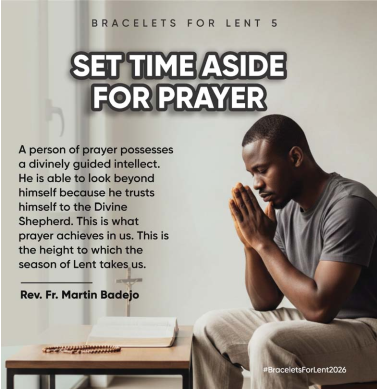
Set time aside for prayer
It matters to have a relationship with God. The way to develop that is through praying. The consistency of our prayer life or otherwise determines how deep our relationship with God our Father can become. More than just praying to him because of our needs, it is more important to create that relationship, such that our prayers will not just be of petitions, but will be driven by a sense of oneness with him. One reason that should inspire us to create time to pray is that a person of prayer possesses a divinely guided intellect. He is able to look beyond himself because he trusts himself to the Divine Shepherd. The words of St. Augustine in his autobiography, Confessions, find meaning here, that, “you have made us for yourself, O Lord, and our hearts are restless until they rest in you.” It is therefore auspicious to set time aside to grow our oneness with the Lord, through prayer.
Remember that the season of Lent is a time to do battle against our flesh, that we may grow in the riches of the soul. Can we really do this when we keep admiring the self? Do we not need to look more to God to guide our hearts that we may follow him? How can we do that without creating a relationship with him? The story of the fall of Adam and Eve features the discourse which the serpent had with Eve. That was it. She let in the brickbat of the serpent to look more to herself, than stay focused on God and God’s directives. Fast forward and compare that with the temptation of Jesus. He never took time to open any discussion with the devil. He gave concise and succinct responses. That tells of staying focused on the mission the Father sent him to fulfill. He was not focused on himself. That is what prayer achieves in us.
Bracelets for lent 6
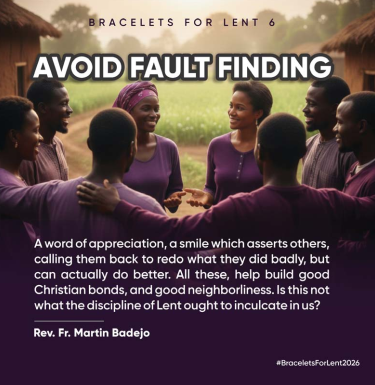
Avoid fault finding
One of the ways by which the ego tries to play out its superiority complex is to push the thought that it always better than others and it plays out in picking faults and holes in what others do. Of course, it the self makes it look easy to point accusing fingers at others. At times we complain and say a lot of negative words over very trivial things that we can either overlook or just decide to do take the responsibility to do better. Even if the situation were bad, rather than correct it, we lay up more layers of problems through fault finding, thereby unsettling ourselves and disorientating others around us. it might even get worse when it leads us to start making reference to similar situations which happened in the past. We can actually help others and help ourselves by reducing or totally avoiding fault finding.
We can correct others or make situations which are truly bad become better when we do so in love and with love. Of course, it demands for closing our eyes a little to the faults of those around us and praising them a little more. A word of appreciation, a smile which asserts others, calling them back to redo what they did badly, but can actually do better. All these, help build good Christian bonds, and good neighborliness. Is this not what the discipline of Lent ought to inculcate in us? A little less of me and more of Jesus in the neighbor? In other words, even if in the worst situation, there is actually some bare fault to find, we should rather do so with the mind of Christ, who will either find an excuse for the one who offended him or correct such a person in love.

• Rev. Fr. Martin Badejo is a Priest of the Catholic Diocese of Oyo.#BraceletsForLent2026