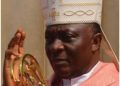
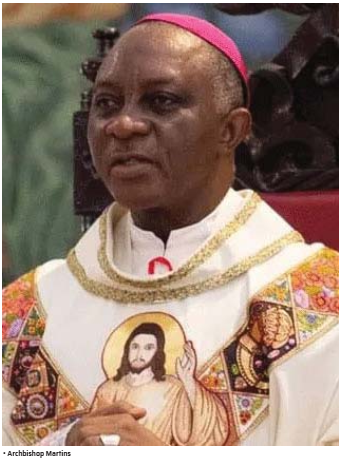
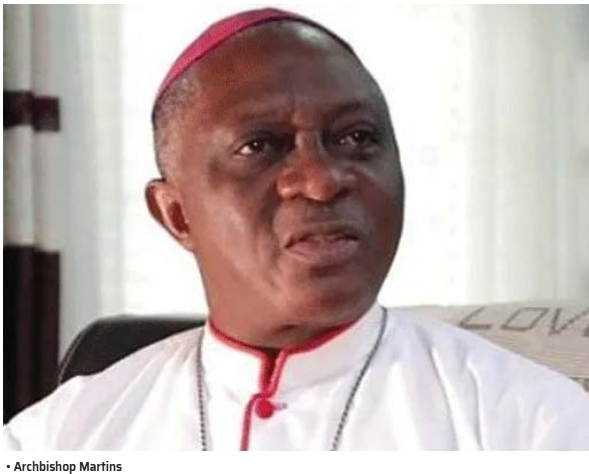
In a wide-ranging interview with ThisDay, Most Rev. (Dr.) Alfred Adewale Martins, Archbishop of Lagos, presents a candid assessment of Nigeria’s worsening insecurity and the growing fears among Christians across the country. Responding to mounting debates over alleged “Christian genocide,” the Archbishop cautions against fixating on terminology while ignoring the troubling patterns of targeted violence, displacement and systemic discrimination. He reflects on the historical and political context shaping these concerns, evaluates recent international reactions, and outlines urgent steps needed to restore security, trust and national cohesion.
Your Grace, thank you for speaking with us. There have been allegations about a “Christian genocide” in Nigeria, which have raised debates across divides. Given your position on national development, is there Christian genocide in Nigeria?
Well, I think the discussion around whether there is genocide or not is capable of obscuring the real issue. The word genocide is not the same as the word rain, for example. Genocide has a definition that is quite different from rain, a word everyone understands without controversy. So I think it is more useful not to focus on the word and leave out the issues. I believe that what is most important is to know the facts and the truth of the situation in our country.
If people are talking about persecution of Christians, there is a context to it, which is important in the whole discussion. I mean, we had a time when Ibrahim Babangida was President of this country and he smuggled Nigeria into the Organisation of Islamic Countries. That is the context in which we are talking about persecution in Nigeria. We know that efforts have been made to put Sharia law into the Constitution of Nigeria. These efforts have been ongoing and they have not ended. We also have states in Nigeria that have Sharia law fully implemented, and it is still so today. Even though Nigeria is a secular state, these efforts have been made, and those states that have introduced Sharia law have people of other religions living in them.
So this is the context in which people are talking about genocide or no genocide. As I said, I do not want to be caught up in the use of the word, but I think we are talking about the fact that people feel persecuted. These killings—the present insecurities, the killings that we have now—you remember that they started many years ago, and it was only churches that were being attacked. It was only Christian institutions that were being attacked. And it went on for a while until, at some point, perhaps because people were becoming conscious of the fact that only churches were being attacked, there were now attacks on other institutions— mosques and the rest. So when you go to the beginning of these insecurities, you find that they started with attacks on Christian institutions.
Unfortunately also, we find that even today many of these attacks, especially on Christians, happen in places populated mostly by Christians—particularly in Benue State, Plateau State, and other similar states. All of this gives the impression that there is an agenda against Christians. And we know too that when these communities are attacked, they are forced to flee to IDP camps. They remain in IDP camps for years while their villages are either left uninhabited or even inhabited by bandits. They cannot go back home simply because bandits have made it unlivable. And most of those communities are populated mainly by Christians. Naturally, this leaves quite an impression. When you also remember the fact that in parts of the North you cannot ordinarily build a church—not because you don’t want to build, but because you do not get the approvals needed from civil authorities—these contexts naturally create the impression that there is a problem for Christians and Christianity in those areas.
When these people are driven from their homes and their homes are occupied by bandits, or made impossible to return to, it naturally leaves a lot to be desired. Then, of course, more recently, we heard about an attempt to introduce—or even inaugurate—an economic strategy with a name that would naturally raise concern. When you call it a National Halal Economy Strategy, naturally it rings a bell in people’s minds, especially when all these other situations are already happening around us.
So I think it is necessary not to get bogged down by words but to face the issues and understand what is happening among us. Thank God that economic strategy was put on hold. I think that was a sensitive and good decision. But we need to go through the House and have public debate. So this is the context in which Christians feel—maybe not only Christians, but Christianity itself feels—it is under persecution.
U.S. President Donald Trump recently designated Nigeria as a “Country of Particular Concern,” after the Biden administration removed Nigeria from the list. How do you respond to Trump’s stance?
Well, again, calling us a country of particular concern has its own implications. But I think what is even more important is that this designation should wake us up to the need to address what brought it up in the first instance. Obviously, President Trump has his own way of expressing his thoughts, feelings, and desires. From a patriotic point of view, you feel uneasy that he is speaking about us in that way. You feel uneasy—why should an independent country be spoken about like that? But at the same time, we need to look at the context and see what we must do to get out of that situation. That is more important than dwelling on what he calls us or does not call us.
Would you say this designation in any way reflects Nigeria’s situation?
Yes, in many ways, when he talks about us as a country of particular interest, we indeed are a country of particular interest because of the situation we are undergoing at the moment. But we need to look beyond our situation as a country. What is happening to us has a global dimension which we cannot ignore. It is important even for Trump himself to recognise that this is not just about Nigeria. Nigeria is, in my understanding, only an example of a bigger agenda in the world that needs to be addressed by all countries.
I believe, for instance, that there is a global effort to introduce another kind of civilisation to our world—one that is believed to be superior to the degenerating culture found in some parts of the world. You see efforts to introduce this new civilisation playing out in different ways. I do not know enough about Al-Qaeda, but Al-Qaeda is often cited as being behind many of these things. There is an effort to change demographics in parts of the world in order to tweak things and introduce a new civilisation. Perhaps that works in some places. But for us, maybe the strategy is to engineer groups like Boko Haram, ISWAP, and others—to use them as tools through which this new civilisation is introduced to Nigeria, the rest of Africa, and beyond.
So even though Trump is concerned about Nigeria being a country of particular concern, he should also be concerned about the effort to introduce a new civilisation. This aggressive effort exists in the U.S. and around the world. Whether it is justified or not is not the issue. What is concerning is the intentional pursuit of it. All peoples need to pay attention to this.
Still within the context of insecurity, Nigeria has witnessed multiple mass abductions of schoolchildren recently. What aspect of this tragedy troubles you the most?
Every aspect of it is troubling. Every aspect of kidnapping children must be troubling. Every child has the right to study in an environment that is safe, secure, and free of threats. That people will go to these schools at all and inflict such trauma is troubling. Carrying children away into forests for ransom is deeply troubling. There is nothing good about kidnapping children from schools. You destroy their childhood, and they will never be the same again. Some are even married off at a tender age, when they are not ready for such stress. It is obviously not good.
What urgent measures would you recommend to the government to protect students across the country?
Government has all the paraphernalia for securing people—the police, the military, and other security agencies. They need to be mobilised more to give a sense of security to staff and students in those schools. There are security experts in government and outside of it. They are the ones who should work these things out so our children are safe. We are doing very badly when our children cannot study in a conducive environment.
Do you think shutting down schools, as we have seen in some northern states and some federal unity schools, is the way out of this situation?
To the extent that children who have suffered trauma need a moment of respite, shutting down schools is appropriate—but only as a temporary measure. There must be ways of ensuring safety that go beyond shutting schools. They must return to school anyway. It is their future we are talking about—the future of the country and their families. Security must be beefed up. Our security experts must work out solutions and ensure that children get what is due to them as citizens.
Many factors have been ascribed to insecurity. In your view, what factors are driving the rise of insecurity today?
As I mentioned earlier, the global issue I spoke about is certainly part of it in my understanding. I also think the story we hear about Boko Haram— that it was introduced for political and electoral purposes— raises questions. What is there to say that the same purposes are not at play again, with 2027 around the corner? One cannot rule that out. Those are factors that, in my view, contribute to the insecurity.
In your recent press statement, you said some elements deliberately want to throw Nigeria into chaos. Can you shed more light on this?
Yes, the elements that want to create chaos are what I mentioned earlier—the global movement targeting our country, Al-Qaeda’s influence, and the local groups they use: Boko Haram, the Lakorawas, the Gwandins, and others. In many ways, these are the elements seeking to create chaos.
And you don’t think it’s a result of leadership failure or weak political will?
My reading is that while these groups create insecurity, we have not had adequate responses for too long. Governments have come and gone; chiefs of the military have come and gone; and after many years the problem remains. For me, this suggests a lack of will to deal with the situation appropriately. People have proposed different solutions, yet we remain where we are. We have even heard—true or false—of instructions given to attack a location, only for counter-instructions to halt it. This shows a lack of will to act as required, and it is unfortunate.
How much of this insecurity stems from socio-economic deprivation?
There is a saying that the idle hand is the devil’s workshop. When people are unemployed, poorly educated, have nothing to look forward to, and are excluded from the social net, a fertile ground is created for insecurity. If many of those recruited by different groups had something tangible to look forward to, most would not join. And those being recruited by force would be less vulnerable if they had opportunities.
How can Nigeria rebuild trust between government and citizens amid these security failures?
Government must show that it pays attention to concerns raised. Christians have concerns now. The only way to build trust is for government to say: “Others didn’t do it; we will ensure it is done.” Not just saying it, but showing it with actions. When people know they are taken seriously, it makes a lot of difference.
As a leader in the Catholic Church, how is the Church contributing to peacebuilding and conflict resolution in Nigeria?
The Catholic Church has contributed to peacebuilding for years. I chair the Church and Society Department of the Catholic Bishops Conference of Nigeria at the Catholic Secretariat. Part of this department is Caritas Nigeria, whose aim is to build peace nationwide and support humanitarian needs wherever they arise. Caritas Nigeria has been present in troubled areas for years. In Kaduna, for instance, we have the Sisters of the OLA engaged in peacebuilding across religious divides. We also have the Justice, Development and Peace Commission across the country, working to help communities live together and do what is right. From time to time, the Conference issues statements on what needs to be done for peace to be established and sustained. The Catholic Church is doing its part.
Do you think religious leaders—Christian and Islamic— have done enough to discourage violence and extremism?
We are trying our best. We constantly teach that every human being is created in the image and likeness of God, and therefore deserves respect, the right to life, and the right to a good life. This is part of the universal social teaching of the Church. We also try not to escalate situations but rather find solutions. I believe we are doing our best.
A prominent cleric, Apostle Johnson Suleiman, recently argued that more attention should be placed on Islamic clerics who inflame tensions. In light of your earlier response, how important is the role of religious leaders in sustaining peace?
I understand that when these issues began, the Sultan of Sokoto and the President of CAN made a joint appeal for peace. That is something. But it should not only be at the apex level. The call should also go downwards—to local churches and mosques. We have heard of situations where sentiments are whipped up in mosques. And perhaps also in some churches. But the important thing is that everyone recognises that war, indiscriminate killings, and aggression help no one. In the end, everyone loses, and the future is jeopardised. All religious leaders—Christian, Islamic, and others— should seek peace.
Do you believe our security agencies are adequately equipped and motivated to tackle these threats? What reforms would you recommend?
I have seen video clips of military personnel saying they do not have adequate equipment. I don’t think any military person would say that if it were not true—it could affect their career. If so, their concerns should not simply result in punishment; they should be investigated and addressed. They need proper equipment and empowerment to act. But as I said earlier, when instructions are given and counter-instructions follow, it creates problems for the men on the field. There has also been discussion about state police. With my little knowledge, I think it is important to consider it carefully. Yes, in the past there were problems—governors misused police. But can our experts not plug those loopholes? I believe we have more to gain with policing in smaller units than in the current centralised structure. It could help secure the nation better.
What message would you give to Christian and Muslim leaders about working together to restore peace in divided communities?
We have an urgent and necessary role to play. When we recognise our common humanity—that we are all children of God and citizens of the country—this should override any other sentiment. Religious leaders must also recognise that their words carry weight. We should be measured and careful. Words are fragile; once broken, they are difficult to mend. Words can create fire rather than peace. We must all be aware of this.
As the shepherd of millions of Nigerian Catholics, what message do you have for Christians and all Nigerians during these perilous times?
We are all Nigerians by the grace of God, irrespective of our differences. And the differences are many. But when we recognise that these differences can be exploited by people for personal and selfish goals, we should be wise and refuse to be set against one another. We must respect one another, respect our positions, respect our differences, but never allow these differences to become sources of conflagration or the burning down of this country. We should preach this, believe it, and live by it.
Finally, Your Grace, what is your single most important appeal to the government and to citizens?
My appeal to government is to try and regain the trust of people from all sections of the country. Christians have a concern at this time. Government needs to listen and take that concern seriously—not downplay or whitewash it, but recognise it and address it meaningfully. Insecurity, at this time, requires adequate attention. Perhaps more than anything else, President Trump’s statement should be seen as a call to action—to solve our problems ourselves. No one should expect Trump or anyone else to come and solve our problems. Every country has its own priorities. So after being angry about how he said it, we must return home and address our situation.